
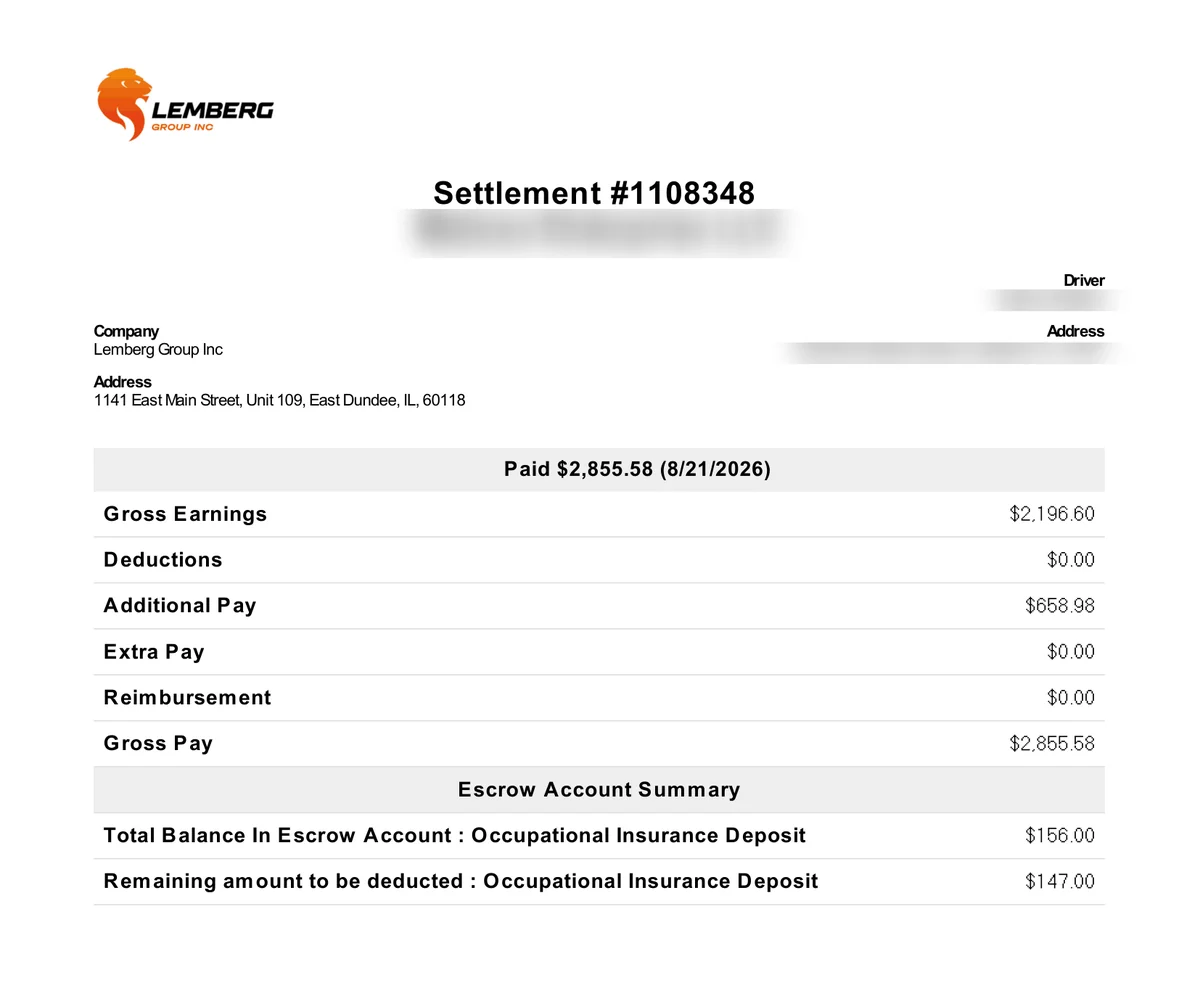
A recruiter can tell you anything about a job. A settlement statement cannot.
It is the one document in this industry that has to add up. Every promise made on the phone either shows up on it as a number, or it was never real. Learning to read one properly takes about ten minutes, and it is the single most useful skill a driver can have when comparing two offers.
What a settlement statement is
It is the weekly accounting of your work: what you hauled, what it paid, what was added, what was taken out, and what landed in your account. Different carriers use different software, so the layout changes, but the structure almost never does.
Every settlement has four blocks, in this order:
- Earnings — the miles and the rate
- Additions — extra pay and reimbursements
- Deductions — everything taken back out
- Net pay — what actually reaches your bank
Read them in reverse order the first time. Start at the net, then work upward to find out why it is that number and not the one you were quoted.
Block 1: earnings, and why the miles matter more than the rate
Two carriers quote you $0.70 a mile. One pays you for 2,900 miles that week, the other for 2,650 on the exact same runs. That is a $175 difference on identical work, and neither of them lied about the rate.
The reason is how the miles are counted. Carriers pay on one of these:
- Practical miles — the route a truck can legally drive, the way a truck GPS calculates it
- Short miles or HHG miles — a household-goods mileage table that assumes routes trucks cannot always take, and usually comes out lower
- Hub miles — the odometer, from pickup to delivery
Practical miles are the most common and the fairest of the three. Hub miles are the most generous, and rare. If your settlement shows fewer miles than your odometer did, that gap is the answer, and it repeats every week for as long as you stay.
Ask before you sign: which mileage standard do you pay on, and can I see it named in writing?
Block 2: additions, the pay most drivers never audit
This is where a settlement quietly separates a good carrier from an average one. The line items to look for:
- Detention or layover pay when a shipper or receiver holds you
- Stop pay for multi-stop loads
- Breakdown pay when the truck is down and you are not
- Reimbursements — tolls, scales, lumpers, permits, washes
- Bonuses — safety, inspection, mileage, referral, sign-on instalments
Two things to check. First, that the ones you were promised are actually there. Second, that they arrive on the week they were earned and not two months later. A bonus that exists in the recruiting pitch but never on paper is not pay.
For our drivers, detention runs $25 an hour after the first two hours, up to $150 a day, and a clean DOT inspection pays up to $300. Home time travel is reimbursed up to $350 for flights and car rental. Those are lines on a settlement, not talking points — the full pay list is on the main page.
Block 3: deductions, where an offer becomes real
Everything above this block is what you earned. This block is what you keep.
Common deductions across the industry, and what to make of each. None of these figures are ours — they are what you may meet at other carriers, and the point of listing them is so you recognise them on somebody else's settlement:
| Line | What it means |
|---|---|
| Escrow / maintenance reserve | A weekly holdback, "refundable" at some point after you leave. $25–$100 a week is typical, which is $1,300–$5,200 a year. |
| Security or truck deposit | $1,500–$2,500 taken off your first checks, a few hundred a week until it is filled. |
| Occupational or health insurance | A real cost with a real policy behind it. Ask whether it is one-time or weekly. |
| Chargebacks | Damage, tyres, repairs. The question is what counts as your fault. |
| Advances | Money you already took, usually via the fuel card. Fair, but check the fee. |
| Late or service penalties | Deductions for a delivery that missed its window — including windows missed by the shipper. |
What each of these costs over a full year, and why "refundable" is doing so much work in that sentence, is covered in what escrow really costs you in your first year.
The dangerous ones are not the biggest. They are the recurring ones. A single $600 chargeback hurts once; $75 a week for a year is $3,900 and nobody ever mentions it again after the first settlement.
What escrow looks like on paper
Escrow rarely appears as one obvious line. It usually shows up as a small weekly amount plus a running balance somewhere near the bottom of the page, often labelled as a summary rather than a deduction.
That balance is your money in someone else's account. Getting it back normally requires perfect paperwork, an equipment inspection, and a waiting period measured in weeks after your final settlement. Drivers chase those balances for months.
For our drivers there is no escrow account, no security deposit and no truck deposit. The one line that does appear is the occupational insurance the policy requires — not a maintenance escrow, and not a weekly holdback.
Leasing on as an owner-operator is a different agreement and it does carry a deposit: $2,500, splittable into 10 weekly payments of $250. Every owner-operator cost is listed on that page, so you can check the arithmetic before you call anyone.
Block 4: net pay, and the number that actually matters
Net pay for one good week tells you very little. Anyone can produce one strong settlement.
What tells you the truth is two consecutive weeks from the same driver, because that shows consistency, and two different drivers in the same period, because that shows the freight is not being handed to one favourite.
That is exactly why we publish the settlements themselves rather than a range. The four most recent are on the main page — more than one driver, different weeks, and only names covered — and you can open each one and read it line by line.
Three things to ask for before you sign anywhere
Send these three requests to any recruiter, including ours. The answers, or the lack of them, will tell you everything.
- A blank sample settlement, with every possible deduction line visible.
- A written total of everything held back over the first twelve months.
- Two real settlements from a current driver in the same division you are being hired into.
A carrier running a clean operation will send all three without hesitating. A carrier that gets vague, changes the subject, or offers a verbal figure instead of a document has answered you anyway.
You are not being difficult by asking. You are reading the contract before you sign it, which is what the paperwork is for.
Driving for a carrier that holds nothing back
Up to $0.80 per mile, 3,500+ miles a week, paid every week. For drivers: no escrow, no deposit, and no chargebacks for normal wear and tear.